
Training Is Not Learning Until Someone Has to Decide
Why information delivery is not behavioural change, and why narrative rehearsal, consequence and conversation belong inside modern learning.
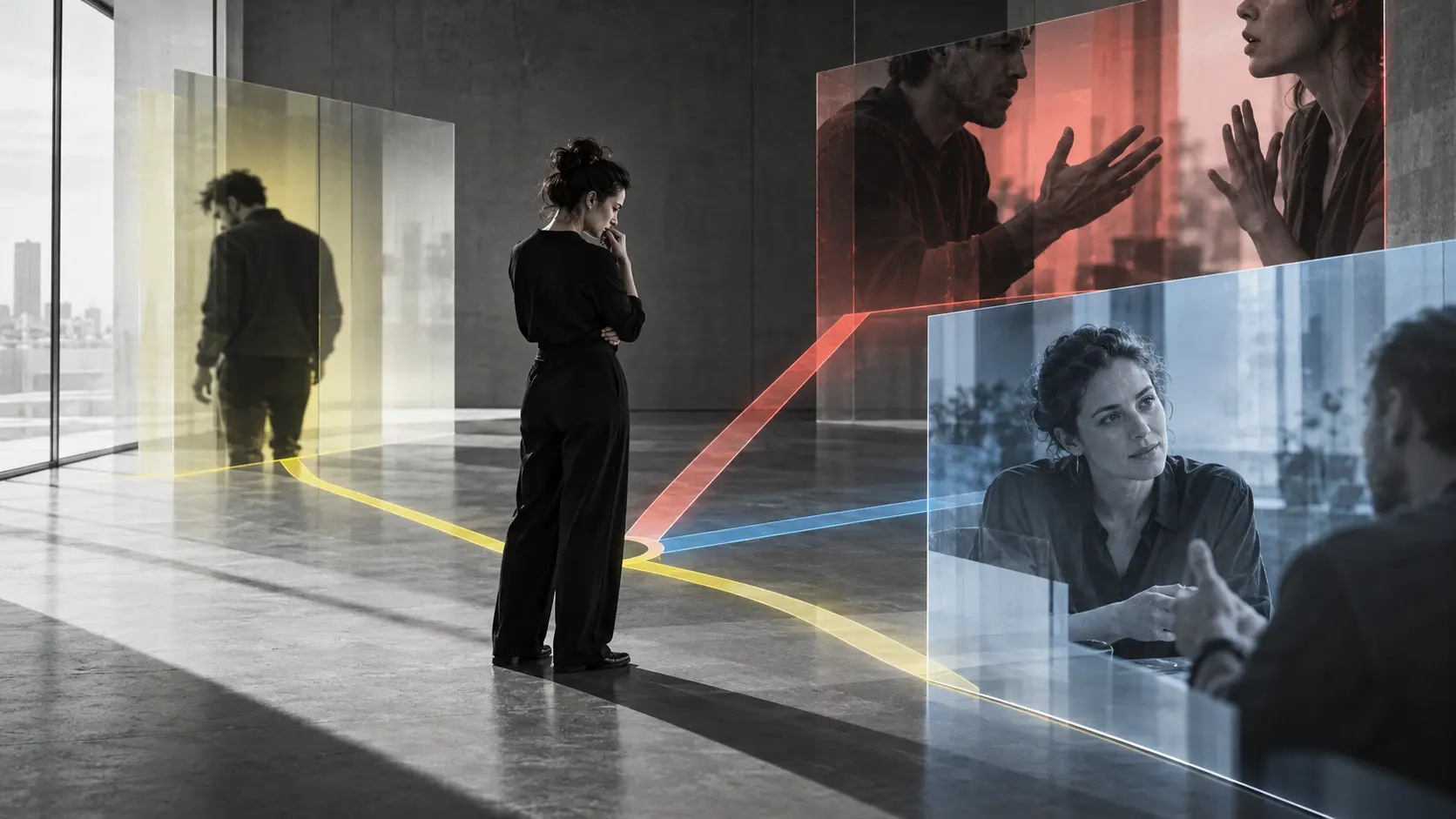
People can complete a module, pass a quiz and still be unprepared for the moment in which judgement actually matters.
Much workplace learning is designed around the efficient transfer of information. Policies are explained. Correct behaviours are described. A short assessment confirms that the learner can recognise the approved answer. The record shows completion. None of this guarantees that the person can act when the situation becomes ambiguous, emotional or time-sensitive.
Knowing is not the same as choosing
A multiple-choice question asked immediately after a presentation often measures recognition. Real work asks for something more demanding: retrieving relevant knowledge, interpreting incomplete evidence, anticipating consequences and communicating a decision to another person.
Research on retrieval practice repeatedly shows that the act of bringing knowledge back to mind strengthens later retention and transfer. Recent work also suggests that stepwise retrieval can improve performance on subsequent problem-solving tasks. The implication is practical: learners need opportunities to reconstruct and use knowledge, not simply encounter it.
“The decisive moment in learning is not when information is delivered. It is when the learner must do something with it.”
Narrative creates the missing pressure
A scenario provides context that an abstract question cannot. There is a person with a motive, a situation with history and a decision whose effects unfold. The learner must notice what matters and decide what to say or do next.
Narrative does not need to turn training into theatre. Its function is to make the decision legible. Why is the customer distressed? What has the manager failed to notice? Which signal in a cybersecurity incident should change the response? What happens to a vulnerable person if the process is followed mechanically rather than thoughtfully?
Simulation-based learning has been associated with improvements in decision-making, particularly when learners receive structured opportunities to practise and reflect. The value comes from rehearsal: a safe environment in which mistakes produce insight before they produce harm.
- OrientGive the learner enough context to understand the situation, without explaining the answer.
- InvestigateAllow questions, evidence gathering and competing interpretations.
- DecideRequire a choice, conversation or action rather than passive recognition.
- Experience consequenceShow how the situation changes because of that decision.
- Reflect and retryMake the reasoning visible and permit another route through the problem.
Conversation changes the kind of practice available
Conversational systems can make rehearsal less predictable. Instead of selecting from four pre-written responses, a learner can formulate a question, explain a judgement or practise a difficult exchange. A character can respond according to the facts and emotional logic of the scenario.
That freedom needs boundaries. The character requires a defined role, knowledge base, objectives and escalation rules. The system needs to distinguish useful variation from incorrect instruction. Human-designed outcomes, feedback and safeguarding remain essential. The purpose is not an unrestricted chatbot; it is a designed encounter.
Measure the decision, not just the visit
Completion remains operationally useful, but it is a weak proxy for readiness. A richer learning system can examine which evidence a participant sought, which risks they noticed, when they changed course, how they explained their choice and whether they improved after feedback.
This creates better questions for organisations. Where do people hesitate? Which misconception appears repeatedly? Do they recognise uncertainty and escalate appropriately? Can they transfer the principle to a different situation? These are closer to the conditions of work than a score attached to content consumption.
Difficulty has to be designed, not performed
A serious-looking simulation is not necessarily a useful one. Pressure, branching and character conflict can make an experience feel sophisticated while obscuring the learning objective. Productive difficulty asks the learner to perform the judgement the real role requires. Everything else should support that act.
The scenario therefore needs a clear model of expertise. What does a capable person notice? Which evidence is relevant? Where is there legitimate ambiguity? Which mistakes reveal a misconception rather than a careless click? Those questions allow the experience to vary without becoming arbitrary.
Debrief turns experience into insight
Consequence alone is not feedback. A learner may see that an outcome went badly without understanding why. A useful debrief connects the decision to evidence, policy, human impact and alternative approaches. It can also distinguish a defensible judgement from a fortunate result.
This is where conversational reflection may become as valuable as conversational roleplay. Asking a learner to explain what they noticed, why they chose a response and what they would do differently makes reasoning available for feedback. The organisation gains insight into patterns, while the individual practises metacognition rather than memorising the approved branch.
Safe practice needs ethical boundaries
Scenario data can reveal confidence, hesitation and misunderstanding. It should not quietly become a surveillance mechanism. Participants need to know what is recorded, who can see it and whether the purpose is development or formal assessment. Sensitive scenarios also require care in representation so that realism does not become unnecessary distress.
The design principle is proportionate evidence: capture only what supports the learning objective, make the use of that evidence explicit and preserve routes for human review. A rehearsal environment earns trust when it is safe not only to make a mistake, but to understand how the mistake will be interpreted.
Learning becomes rehearsal
The future of digital learning is not simply more content generated more quickly. It is the design of environments in which people can investigate, decide, converse and see consequence. Film, interactive narrative, behavioural insight, data and conversational AI can all contribute—but only when they serve a credible decision.
Training becomes learning when the participant is no longer watching the correct behaviour from a distance. They are responsible for what happens next.