
A Digital Twin Needs a Point of View
Data and simulation do not explain themselves. Narrative, interface and purpose turn a virtual replica into something people can use.
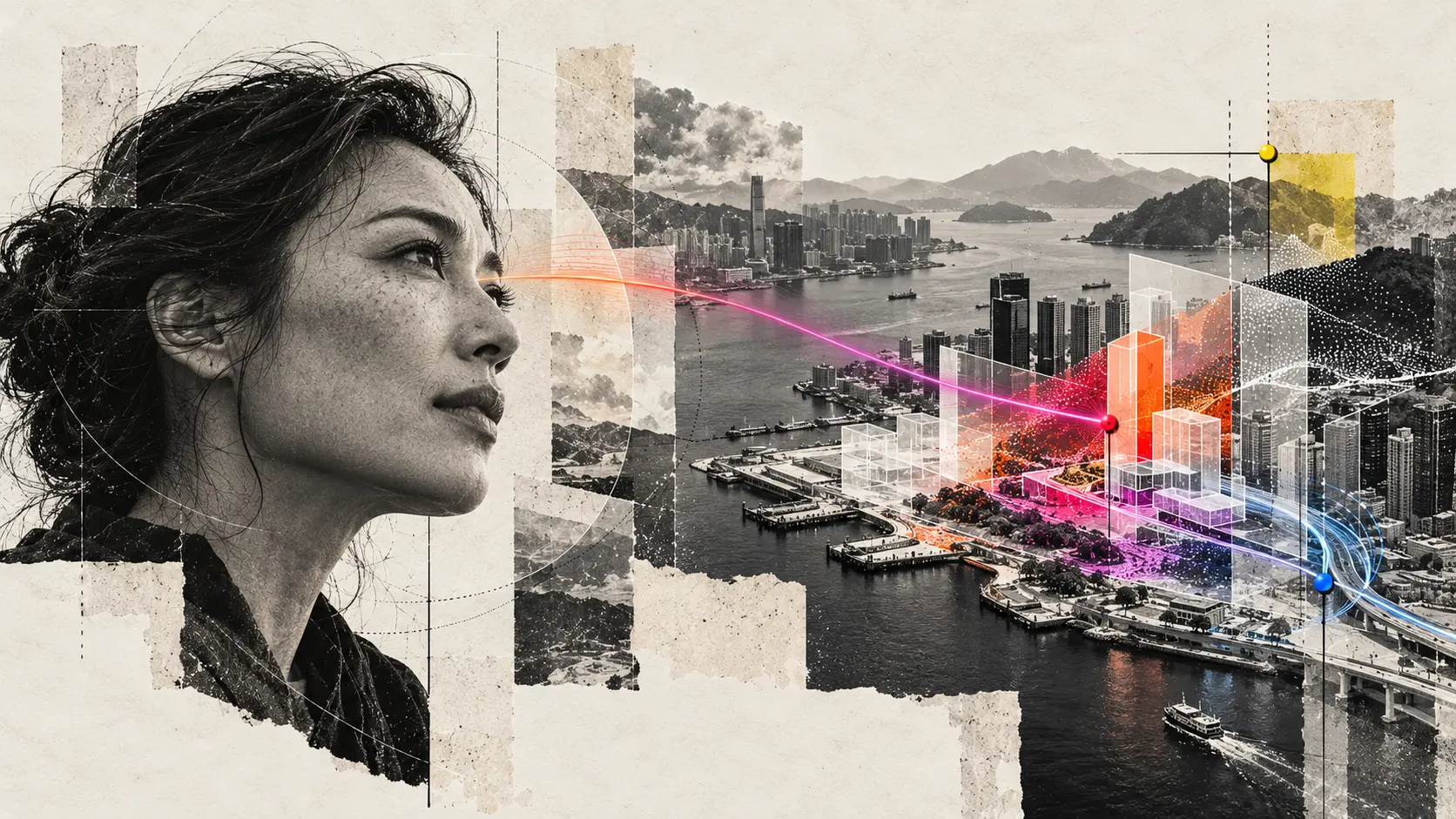
The most detailed representation of a place can still fail if nobody has decided whose decision it exists to improve.
Digital twins are often introduced through scale: buildings reconstructed in three dimensions, systems connected to live data, cities represented as navigable models. Technical fidelity is impressive, but fidelity alone does not make a twin useful. A user can be surrounded by accurate information and remain unable to answer a simple question.
A twin is a relationship, not a render
The UK National Digital Twin Programme describes a digital twin as a digital representation of a real-world entity or process that is synchronised at a specified frequency and fidelity. Synchronisation is important because it distinguishes a twin from a static visualisation. Yet even a living representation needs a purpose.
A property buyer, facilities manager, planner and emergency responder may examine the same place, but they do not need the same twin. Each role asks different questions, trusts different evidence and acts at a different level of consequence.
“A useful twin is not an encyclopaedia of everything known. It is a point of view on what matters for a particular decision.”
Start with the decision
The temptation is to begin with available data: maps, sensors, BIM files, demographic sources, transport feeds and environmental records. A more productive sequence begins with the decision the experience must support.
Should a buyer understand how sunlight moves through a future apartment? Should a visitor know which route matches their access needs? Should a planner compare how different interventions affect a neighbourhood? The decision determines the data, level of fidelity, time horizon and interface.
- ActorWho is entering the experience, and what authority or responsibility do they hold?
- DecisionWhat must they understand, compare or choose?
- EvidenceWhich sources are relevant, current and sufficiently trustworthy?
- ModelWhat spatial, temporal or behavioural relationships need to be represented?
- InterfaceHow should the user question, navigate and manipulate those relationships?
- ConsequenceHow will the experience reveal the effect of a choice?
Open data does not arrive with meaning attached
Public datasets can make sophisticated prototypes possible without proprietary infrastructure. Planning information, mapping, transport, environment and demographic sources can be combined to reveal relationships that no single dataset contains.
But availability is not interpretation. Data carries scope, age, uncertainty and bias. It must be selected and framed honestly. A persuasive interface can make a weak inference feel more certain than its evidence allows. The twin needs visible provenance and a way to distinguish observed facts, calculated outputs and speculative scenarios.
Narrative is an interface to complexity
Narrative does not mean inventing a story around the data. It means organising the experience around a sequence of human questions. Where am I? What am I looking at? Why does this matter to me? What changes if I choose differently? What should I do next?
In a property experience such as Synth Space, this can connect architectural visualisation to local context, specification, live availability and conversational guidance. The buyer is not handed a database. They are given a coherent route through the evidence relevant to their decision.
Fidelity should be selective
More detail can make a twin slower, more expensive and harder to understand. The right fidelity is the minimum required to support the intended decision responsibly. A highly detailed building model may be necessary for maintenance but distracting in an early public consultation. A simplified spatial experience may be more useful if it exposes the right relationships.
This selectivity is not a compromise. It is design. The point of view determines what becomes foreground, what remains available on demand and what is deliberately excluded.
Time is often the most important dimension
A model of what exists now may be useful, but many decisions concern what could happen next. How will a place feel at a different time of day? What changes as a development is occupied? How does a service respond when demand increases? Which effects are immediate and which accumulate?
A twin can make these temporal relationships explorable, but scenarios need to be distinguished from predictions. Assumptions should be visible. Users should be able to understand which variables changed and how sensitive the outcome is to those choices. Otherwise simulation becomes a persuasive animation with no accountable reasoning beneath it.
Conversation can become a navigation layer
Complex models often assume that the user knows where to look. A conversational layer can allow somebody to begin with their own question: show the accessible route, compare these two homes, explain the change in footfall or identify the evidence behind this claim. The answer can then move between language, map, model and data visualisation.
The conversation should not conceal the model. It should help the user locate and interrogate it. A good response identifies relevant evidence, shows it in context and allows the person to continue exploring rather than presenting a final oracle-like conclusion.
Shared twins need shared governance
When multiple organisations contribute data or rely on an outcome, technical interoperability is only part of the challenge. Participants need agreement on ownership, permitted use, update responsibility, security and how conflicting sources are resolved.
The point of view must therefore be declared rather than disguised as neutrality. Who commissioned the experience? Which users participated in its design? Whose interests are represented in the available scenarios? Transparency about perspective makes a twin more credible because it allows people to understand the frame through which the data is being interpreted.
The twin should change what someone can do
The strongest test is behavioural. After using the experience, can the person make a better comparison, ask a more informed question, rehearse a response, identify a risk or progress a decision? If nothing changes beyond admiration for the visualisation, the twin may be technically impressive but operationally weak.
A digital twin becomes valuable when synchronised evidence, modelling, interface and narrative converge around a human purpose. It does not merely resemble the world. It helps someone understand how to act within it.