
For twenty years, the goal of digital marketing was simple: rank high, earn the click and convert the visitor. That model is being disrupted by a new layer of search.
Customers are increasingly turning to AI systems to ask direct questions and receive synthesised answers. They are not always browsing lists of links. They are asking a model to decide what is relevant, trustworthy and worth citing.
If your organisation is not represented in those answers, the problem is no longer that you are on page two. The problem is that you may be absent from the conversation entirely.
“SEO was about being found. AEO is about being selected.”
The Architecture of the Great Filter
The Great Filter is the process through which AI systems sift through vast amounts of information and decide which sources are credible enough to shape an answer.
Traditional search engines ranked pages. Answer engines synthesise information. They look for useful fragments, clear explanations, consistent entities and defensible claims.
This changes the strategic objective. The question is no longer simply whether a page can rank. It is whether the organisation can be understood, trusted and cited by the systems increasingly mediating discovery.
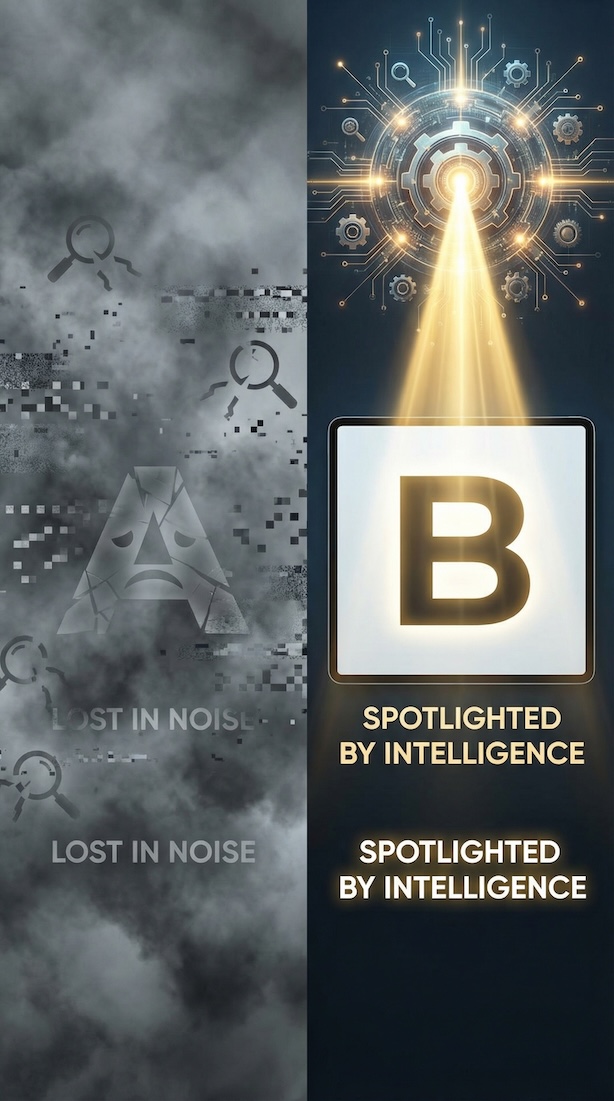
From Search Visibility to Answer Visibility
AI systems do not simply reward attractive websites. They reward clarity, structure, consistency and evidence.
That means content must be organised so both people and machines can understand what the organisation does, what it knows and why its claims should be trusted.
From Links to Citations
Trust has always been central to brand authority, but AI changes how that trust is evaluated.
Answer engines compare information across multiple sources. They look for agreement, depth, structured data, recognisable entities and original material. A brand with inconsistent descriptions, vague claims and fragmented content is harder to interpret and easier to omit.
Answer Engine Optimisation is therefore not a collection of isolated technical tricks. It is the coordinated work of making an organisation legible, credible and useful across the wider digital environment.
Clear headings, concise factual explanations and well-defined entities make content easier for AI systems to extract and represent accurately.
“When an AI system cites your organisation, it has already transferred part of its trust to your brand.”

Surviving the Zero-Click Reality
Many marketers fear search journeys in which the user receives an answer without visiting a website.
But citation can create a more qualified form of visibility. By the time a user chooses to visit or make contact, the AI system may already have positioned the organisation as a credible authority.
The Strategy of Authority
To perform well in AI-mediated search, an organisation needs more than isolated articles. It needs a coherent knowledge footprint.
This means covering the subject deeply enough that the brand becomes strongly associated with the topic, while maintaining consistency across website copy, structured data, profiles, articles and third-party references.
The objective is not to manufacture artificial authority. It is to make genuine expertise easier to detect.
Covering a subject from multiple useful angles so the organisation becomes strongly associated with the field.
Using schema and clear page architecture to define entities, relationships, services and authorship.
Publishing proprietary insight, research, examples and data that other sources cannot simply reproduce.
Keeping names, descriptions, expertise and organisational information aligned across the digital footprint.
Why AEO Is More Than Content Formatting
AEO is often reduced to writing shorter answers or adding FAQ schema. Those tactics can help, but they do not solve the deeper problem.
AI systems build understanding from the relationship between many signals. Website structure, editorial depth, external references, brand consistency and technical markup all contribute to whether an organisation is represented confidently.
This is connected intelligence applied to discoverability: narrative, data and technical structure working together around one coherent representation of the organisation.
What Comes NextBecome the Answer
In the age of AI search, silence is increasingly similar to nonexistence.
The organisations that remain visible will be those that explain themselves clearly, demonstrate real authority and publish information that both people and machines can use with confidence.
The objective is not simply to appear in more search results. It is to become one of the sources through which the market understands the subject.